


Health Insurance Open Enrollment
with NaviLexis Solutions

Medicare
Open Enrrolment! Book an Appointment
What it is: U.S. federal health insurance program.
Who it covers:
Adults 65 and older.
People under 65 with qualifying disabilities (after waiting period).
Individuals with End-Stage Renal Disease (ESRD) or ALS (special rules).
Guaranteed coverage: Eligible individuals cannot be denied based on age, health status, or pre-existing conditions.
Core Parts of Medicare
Part A (Hospital Insurance): Inpatient care, skilled nursing, home health, hospice.Usually premium-free (10+ years work history).Deductibles + daily copays apply.
Part B (Medical Insurance): Doctor visits, outpatient, preventive care, labs, DME.Monthly premium (income-based), annual deductible, 20% coinsurance.
Part D (Prescription Drugs): Private drug plans.Each plan has own formulary, tiers, network, costs.Late penalty if you delay without credible coverage.
Original Medicare (A + B)
Option 1
Add-ons: Part D (drugs) + Medigap (supplement).
Pros: Nationwide access, no networks or referrals.
Predictable costs with Medigap.
Best for frequent travelers & multiple specialists.
Cons: Multiple premiums (B, D, Medigap).
No built-in extras (dental, vision, hearing, transportation, gym, etc)
Medicare Advantage (Part C)
Option 2
Private plans bundling A + B + usually D.
Extras included: dental, vision, hearing, OTC, transportation, gym, flex cards.
Types: HMO, PPO, PFFS, SNP (e.g., D-SNP, C-SNP).
Pros: One card, extra benefits.
Out-of-pocket max protection.
Often low.
Cons: Networks + prior authorizations.
Benefits can change yearly.
Travel limits outside service area (except emergencies).
Medicare + Other Coverage
Option 3
Employer/Union Coverage: Retiree health benefits alongside Medicare.
VA / TRICARE for Life: Military or veterans’ health coverage coordinating with Medicare.
Dual Eligible (Medicare + Medicaid): Access to Special Needs Plans (D-SNP).
ACA Marketplace
Open Enrrolment! Book an Appointment
What it is: Online platform (HealthCare.gov or state exchange) for individuals/families to buy health insurance.
Guaranteed coverage: No denials for pre-existing conditions.
All plans must cover 10 Essential Health Benefits: Doctor & hospital care, ER, maternity/newborn, mental health & substance use, prescriptions, labs, pediatric (incl. dental/vision), rehab/habilitation, preventive care, chronic disease management.
Financial Help
Subsides
Premium Tax Credit (PTC):
Lowers monthly premium based on income & household size.
Available up to ~150–400%+ of Federal Poverty Level (FPL).
Many qualify for very low.
Cost-Sharing Reductions (CSR):
Extra savings on deductibles, copays, OOP max.
Only on Silver plans & for incomes ~100–250% FPL.
Reconciliation at tax time: IRS adjusts subsidy based on actual income.
Metal Plan
Levels
Bronze: Lowest premiums, highest costs when you use care. For minimal users.
Silver: Mid premiums, access to CSR savings.
Best value for subsidy-eligible.
Gold: Higher premiums, lower cost-sharing.
Good for frequent care users.
Platinum: Highest premiums, very low cost-sharing.
Rare, best for heavy care users.
Networks & Plan Types
Option 3
HMO: Lowest cost; in-network only; referrals needed.
EPO: In-network only; usually no referrals.
PPO: More flexibility; some out-of-network coverage; higher premiums.
⚠️ Tip: Always check if your doctors, hospitals, and pharmacies are in-network.

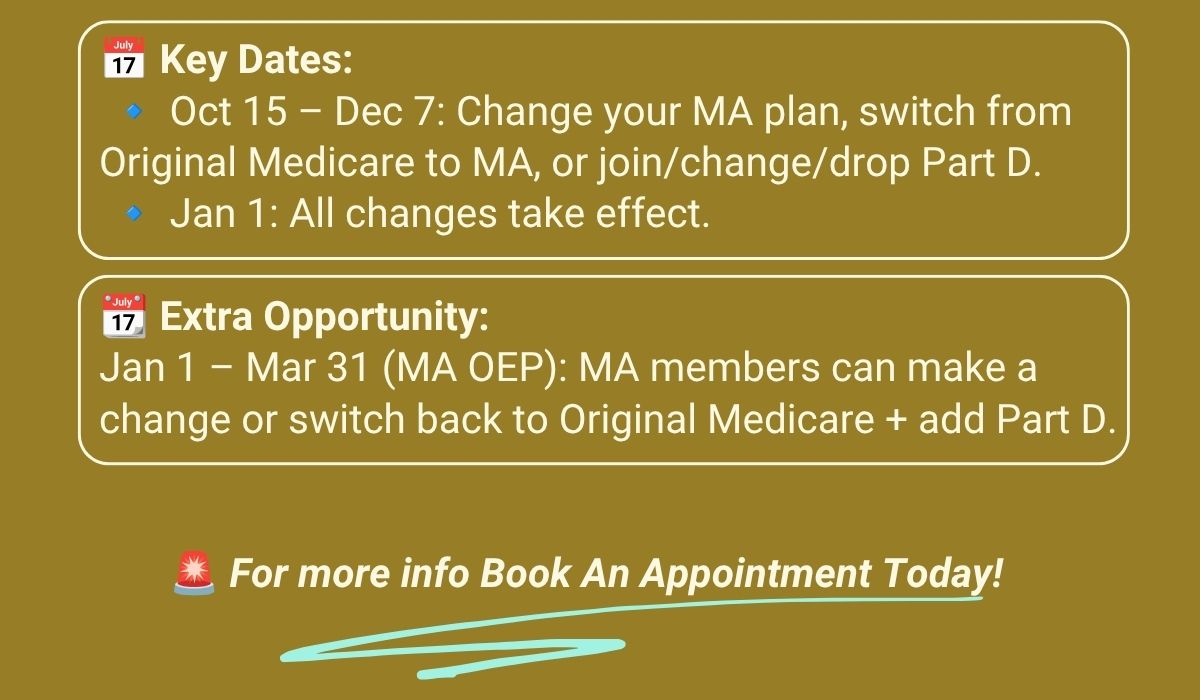
MEDICARE AEP
Annual Enrollment Period
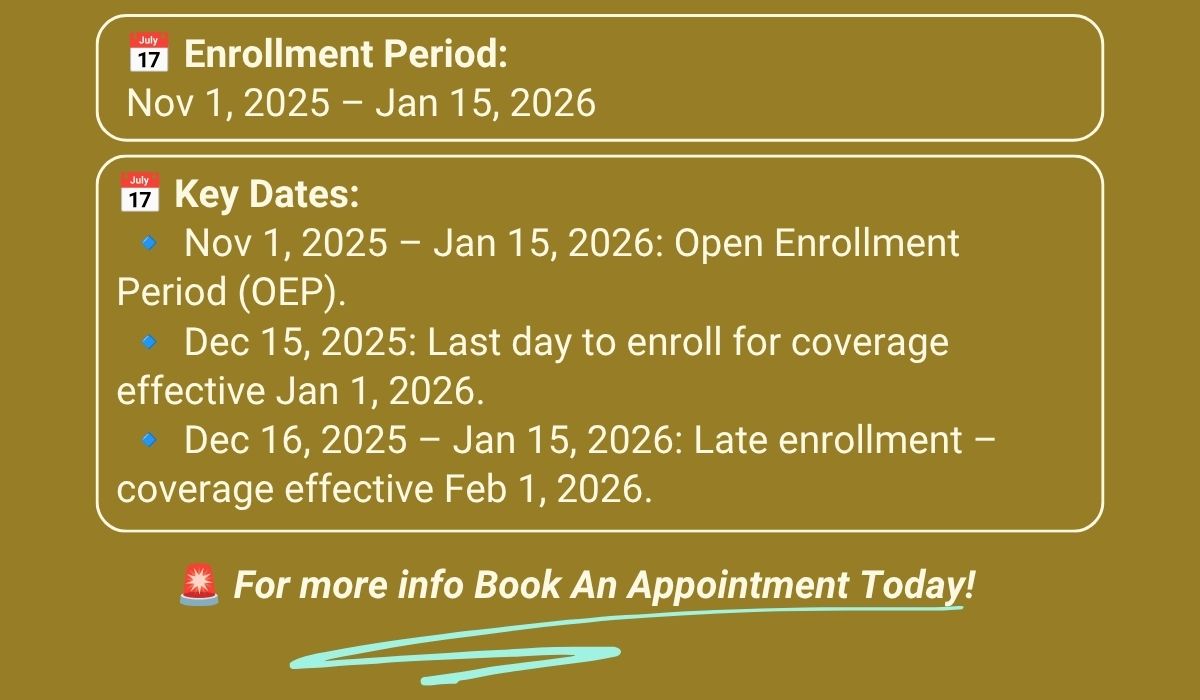
ACA AEP
Annual Enrollment Period
STILL NOT SURE?
Frequently Asked Questions
Medicare AEP
What if I miss the deadline?
If you don’t make changes during AEP (Oct 15 – Dec 7), you’ll usually have to wait until next year, unless you qualify for a Special Enrollment Period (SEP) (e.g., moving, losing coverage, Medicaid eligibility, certain health conditions). Your current coverage will continue into 2026 if no changes are made.
Can I change my plan more than once?
Yes. You can submit multiple requests during AEP, but only the last one before Dec 7 will take effect on Jan 1. If you have a Medicare Advantage plan, you also have the MA OEP (Jan 1 – Mar 31) to make one more change or go back to Original Medicare + Part D.
What can I change during AEP?
Switch between Original Medicare and Medicare Advantage. Change from one MA plan to another.
Join, drop, or switch a Part D drug plan.
When do changes take effect?
All AEP changes start on Jan 1 of the following year.
What if I have Medicaid or Extra Help?
You may qualify for Special Enrollment Periods and can change plans multiple times during the year.
ACA MARKETPLACE AEP
What if I miss the deadline?
If you don’t enroll or renew during Open Enrollment (Nov 1 – Jan 15), you can only get coverage if you qualify for a Special Enrollment Period (SEP) (e.g., loss of other coverage, moving, marriage/divorce, birth/adoption, income changes). Otherwise, you’ll need to wait until the next year.
Can I change my plan more than once?
Yes. You can change plans as many times as you want during Open Enrollment; only the last plan selected before Jan 15 will take effect. After Jan 15, changes are only allowed with a SEP.
When does my coverage start?
Enroll by Dec 15 → Coverage starts Jan 1.
Enroll Dec 16 – Jan 15 → Coverage starts Feb 1.
Can I get financial help?
Yes. Most people qualify for tax credits and cost-sharing reductions based on income and household size.
What info do I need to enroll?
Income details, household members, immigration documents (if applicable), list of preferred doctors and prescriptions.
What if I don’t pay my first premium?
Your coverage won’t begin until you make the first payment.
©NaviLexis Solutions LLC Copyright 2025, All Rights Reserved
We do not offer every plan available in your area. Currently, we represent 8 organizations which offer 78 products in your area. Please contact, 1-800-MEDICARE, or your local State Health Insurance Assistance Program (SHIP) to get information on all of your options.
Contact Us
Tulsa, OK